
Religion
How We Believe
Religion for Curious Minds
An introduction to faith, practice, and the search for meaning
Introduction
Religion is one of the oldest and most stubborn features of human life. Long before laboratories and nation-states, people gathered to pray, to bury their dead with care, to tell stories about where the world came from, and to ask what, if anything, we owe to one another and to whatever lies beyond us. That impulse has never really gone away. It has only changed clothes.
You do not need to be religious to find this subject worth understanding. You also do not need to give up your faith to look at it clearly. Religion has comforted people in grief, given shape to their days, and inspired astonishing kindness. It has also been used to justify cruelty, exclude outsiders, and protect power. Both of those things can be true at once. A good primer should be honest about both.
This book is written for a curious reader, not a specialist. There is no exam at the end, and no attempt to convert you to anything. The aim is simpler: to make religion less mysterious without making it small. We will look at what people mean by the sacred, why ritual matters, how stories and scriptures work, how the great traditions differ, and why belief can be a source of both peace and trouble.
A word about tone. Religion is not only a set of theories. For billions of people it is a home. It is the language they use at births and funerals, the calendar that marks their year, the community that shows up when someone is ill. If we talk about it as if it were only an odd puzzle, we miss the human heart of the thing. If we talk about it only with reverence and never with questions, we miss the hard parts. This book tries to walk in the middle: respectful, plain, and unafraid of difficulty.
We will not cover every faith, every saint, or every argument. That would take a library. What we can do is build a map. Once you have the map, you can travel further on your own, whether that means reading a scripture, visiting a place of worship, or simply listening more carefully to someone whose life is shaped by belief.
So let's start with the question that looks simple and isn't: what is religion, actually?
Chapter 1
What Religion Actually Is
Ask ten people what religion is and you may get ten answers. Some will say it is belief in God. Some will say it is a set of rules. Some will say it is community. Some will say it is a way of explaining the universe before science came along. Each of those captures a piece. None of them quite covers the whole field.
A workable starting point is this: religion is a shared way of living toward what people take to be ultimately real and ultimately important. That "ultimately" is the key. Plenty of things matter to us — work, family, football, money. Religion claims there is something that matters in a deeper way, something that can judge or bless the rest of life. People then organise stories, practices, and communities around that claim.
Notice that this definition does not require a single God. Some traditions are centred on one God. Some speak of many gods. Some, like certain forms of Buddhism, are less concerned with a creator and more concerned with awakening, suffering, and release. If we insist that religion means "belief in God," we quietly leave a large part of humanity out of the picture.
Religion is also more than private opinion. A person can have spiritual feelings alone in a forest. That may be important. But religion, as historians and anthropologists usually mean it, has a public and inherited shape. There are songs other people already know. There are gestures children learn by watching. There are buildings, festivals, leaders, and arguments that began long before we arrived. You step into a stream that was already flowing.
Why does it exist at all? There is no single accepted answer, and that is all right. Some thinkers emphasise comfort in the face of death. Others emphasise social glue: shared ritual helps groups hold together. Others point to the human hunger for meaning. Others see religion as an attempt to live in right relation with powers that feel larger than us. These explanations can overlap. A funeral, for example, can comfort the living, bind a family, honour the dead, and express a hope about what comes next, all in the same hour.
It helps to separate three layers that often get mixed together. There is belief: what people hold to be true. There is practice: what they do — pray, fast, give, sing, keep a Sabbath, make a pilgrimage. And there is belonging: who they stand with. In real life these layers lean on each other. Someone may keep the practices because of the people, or hold the beliefs because the practices have become part of who they are. Looking at only one layer gives a thin picture.
Religion is not the same as morality, though they often travel together. Plenty of religious people are kind, and plenty of non-religious people are kind. Plenty of both can be selfish. Religion gives many people a language for goodness, but goodness is not its private property. Likewise, religion is not the same as culture, though they intertwine so tightly that pulling them apart can feel artificial. Food, dress, language, and family custom often carry religious meaning without anyone making a speech about it.
If you grew up inside a tradition, some of this will feel obvious and some of it may feel too cool-headed. If you grew up outside any tradition, some of it may feel like watching a play whose plot everyone else already knows. Both reactions are useful. Religion looks different from the inside and the outside. A fair account tries to take both views seriously.
By the end of this chapter, the picture should be a little less blurry. Religion is a shared way of orienting life toward what people take as ultimately real and important. It lives in belief, practice, and belonging, and it is older, wider, and more human than any one slogan can capture.
Chapter 2
Belief, Meaning, and the Sacred
Belief is the part of religion that gets the most arguments and, sometimes, the least understanding. We talk as if religion were mainly a list of statements: God exists, the soul survives, this book is holy, that path is true. Those statements matter. But people rarely live by statements alone. They live by what those statements make possible — hope, duty, fear, gratitude, a sense that life is going somewhere.
Meaning is the quieter companion of belief. Human beings are meaning-seeking creatures. We do not only want to survive. We want our days to add up to something. We want suffering not to be pointless, love not to be accidental, and death not to be the last word if we can help it. Religion has been, for most of history, the main workshop in which those wants were given shape.
The sacred is the name many traditions give to what must not be treated casually. A sacred place is not just pretty. A sacred text is not just old. A sacred day is not just a day off. The sacred draws a line and says: here you slow down, take off your shoes, watch your words. That line can look strange from the outside. From the inside it often feels like coming home to the thing that makes the rest of life hold together.
People meet the sacred in different ways. Some meet it in silence. Some meet it in loud music and crowded festivals. Some meet it in a desert, some in a kitchen blessing over bread. There is no single religious temperament. The contemplative and the organiser, the mystic and the rule-keeper, the doubter who still shows up — they can sit in the same congregation and be after slightly different things.
Faith, in many traditions, is not the same as being sure. It can mean trust. It can mean loyalty when the evidence feels thin. It can mean continuing to live as if love and justice matter even when the world looks otherwise. That is why arguments that treat faith as a failed science experiment often talk past religious people. They are not always offering a theory of the universe. Sometimes they are offering a way to stand inside it.
None of this means beliefs are beyond question. If a tradition claims something about history, nature, or human beings, those claims can be examined. Religions have always argued among themselves about what is true. The point is only that belief is thicker than a tick-box. It is tied to love, identity, memory, and hope. If you pull one thread, several others move.
Meaning can also fail. People lose faith. People feel abandoned. People find that the old words no longer reach the new pain. That experience belongs in any honest account of religion. Night and drought are part of the story, not an embarrassing footnote. Some of the deepest religious writing was produced by people who were not feeling triumphant at all.
By the end of this chapter, belief should look less like a quiz and more like a relationship to meaning. Religion offers people a sense that some things are sacred, that life can be interpreted, and that trust is sometimes asked of us before certainty arrives.
Chapter 3
Ritual, Practice, and Belonging
If you want to understand a religion, watch what people do, not only what they say. Ritual is religion made visible. It is the repeated act that says, without a lecture, this matters. Lighting a candle. Washing before prayer. Breaking bread. Walking around a shrine. Sitting in silence at dawn. These actions look simple until you try to invent a substitute that carries the same weight.
Ritual works on the body as much as on the mind. You stand, bow, kneel, sing, fast, feast. You use your hands. You mark time with the year rather than only with the clock. Over time the body learns the faith in a way the intellect alone cannot. That is why people who have drifted from belief often still feel something at a funeral hymn or a festival smell. The practice got there first and stayed later.
Ritual also creates a we. A wedding is not only two people making a promise. It is a community witnessing the promise. A weekly gathering is not only personal devotion. It is a reminder that you are not the first person to carry this hope and will not be the last. Belonging can be warm and it can be stifling. Both are part of religious life. Communities comfort their members and sometimes police them.
Practice includes the unspectacular stuff: giving money, visiting the sick, keeping a dietary rule, telling the truth when it would be easier not to. Grand theology gets the books written. Ordinary faithfulness is what most religious lives actually look like. If we only study founders and miracles, we miss the quiet majority who are trying to get through the week without betraying what they say they love.
Not all practice is ancient. New rituals appear. Old ones fade. A tradition that cannot bend at all becomes brittle; a tradition that bends into whatever the moment wants may lose its shape. Living religions are always negotiating that tension. You can hear it in arguments about music, dress, gender roles, and which language the prayers should use.
Outsiders sometimes call ritual empty. Insiders sometimes call it the only honest part. There is a grain of truth in both. Ritual can become theatre with no heart. It can also carry people when their heart is too tired to generate feeling on demand. Showing up is not nothing. In many traditions, showing up is the beginning of wisdom.
Belonging has a shadow side worth naming. Groups that give identity can also draw hard lines against those who leave or never joined. Hospitality and suspicion have both been religious habits. A fair reader notices which one a community is practising, rather than assuming that religion automatically produces either kindness or cruelty.
By the end of this chapter, religion should look less like a set of ideas sitting on a shelf and more like a pattern of doing. People become religious, and stay religious, as much through practice and company as through argument.
Chapter 4
Stories, Myths, and Sacred Texts
Religions are full of stories. Some are told as history. Some are told as parable. Some sit in that fertile middle ground where a community says, this happened, and also this is always happening. If you try to force every sacred story into a modern newspaper style, you will misunderstand a lot of them. If you treat them all as mere fiction, you will misunderstand a lot of the people who live by them.
Myth, in the older sense, is not simply "a story that is false." It is a story that a community uses to say who they are, where they came from, and what the world is like at the deepest level. Creation stories, exile stories, liberation stories, and stories of a coming restoration do this work. They are maps of meaning. Maps are not the landscape, but you would be unwise to travel without one.
Sacred texts occupy a special place. They are written, copied, translated, argued over, kissed, ignored, memorised, and weaponised. A scripture is not just a book. It is a book a community has decided it cannot do without. That decision changes how the words are read. People do not usually skim a holy text the way they skim a manual. They return to it. They let it read them back.
Interpretation is where the living work happens. The same verses have been used to bless the poor and to defend the powerful. That is not an accident of one tradition; it is a pattern. Texts do not interpret themselves. Communities do, with their histories, fears, and hopes in play. This is why knowing a quotation is not the same as knowing a religion. You also need to know who has been doing the quoting, and why.
Oral tradition came first in many places. The written page arrived later and never fully replaced the voice. Sermons, songs, recitation, and family telling still carry religion more effectively than silent reading for a great many people. If you only meet a faith in a library, you meet a thinner version of it.
Stories also travel. They cross borders, pick up local colour, and sometimes change sides. A tale that began in one language becomes a proverb in another. A saint's life becomes a folk play. Religion is less like a sealed vault of original documents than like a long conversation in which the first speakers still matter and the later ones keep answering.
There is a tenderness in this, if you let yourself feel it. People have carried these stories through famine, migration, and loss because they found in them a way to remain human. That does not prove the stories true in every factual detail. It does prove they have been useful in the deepest sense: they have helped people live.
By the end of this chapter, sacred stories should look less like primitive science and more like a community's attempt to tell the truth about meaning. Texts matter, but so do the voices that keep reading them aloud.
Chapter 5
God, Gods, and the Unseen
For many people, religion is first of all about God. Not an idea of God, but God: the one to whom you speak when no one else can help, the presence that makes a room feel different, the judge, the parent, the mystery. It is worth slowing down here, because this is where outsiders and insiders most often talk past each other.
The word God does not mean the same thing in every tradition. Some speak of a personal God who knows your name. Some speak of an ultimate reality that is not a person in any ordinary sense. Some speak of many gods with different domains. Some speak of spirits in places, ancestors who remain near, or a sacred order woven through nature. If we flatten all of this into one picture, we will keep being surprised by actual believers.
The unseen is larger than theology. People have lived with a sense that the world is not exhausted by what can be weighed and photographed. Dreams, omens, answered prayers, uncanny coincidences, the feeling of being accompanied — these experiences are widely reported. A scientific culture is right to test claims. It is less wise to pretend that the hunger for the unseen is only a mistake made by people who have not yet read the right book.
Prayer is one of the most human of religious acts. Sometimes it is petition: please help. Sometimes it is thanks. Sometimes it is complaint. The psalms, to take one famous example, are full of people telling God off. That fact alone should complicate the cartoon of religion as blind submission. Relationship, if it is real, includes argument.
Atheism and agnosticism belong in this chapter too, not as enemies dragged on stage but as part of the same human conversation. Some people look at the world and cannot find a God they can believe in, especially after suffering. Some find the question unanswerable and refuse to pretend otherwise. Religious traditions have always had their own doubters sitting in the pews. The line between faith and unbelief is not a wall. For many people it is a hallway they walk more than once.
Idols, in the moral sense, are not only statues. They are anything finite that we treat as ultimate — a nation, a leader, a market, an image of ourselves. Several traditions are very sharp about this. They worry less that people will believe in nothing and more that people will worship the wrong thing with religious intensity. That warning still has work to do in a secular age.
It is possible to speak about God without shouting and without sneering. That may be the most useful skill this subject can teach. You do not have to share a person's picture of the unseen in order to recognise that they are pointing at something they experience as real. You can ask what that picture does in their life. Does it make them smaller and crueller, or larger and more just? That question is often more revealing than a debate about proofs.
By the end of this chapter, talk of God should feel less like a yes-or-no exam. Traditions imagine the unseen in different ways, people pray for different reasons, and the live question is not only whether something is there, but what kind of life a particular vision of the holy makes possible.
Chapter 6
Morality, Duty, and the Good Life
Religion and morality have been neighbours for so long that many people assume they are the same house. They are not. But they share a wall. Most traditions do not only say what is real. They say what is required. Do not steal. Honour your parents. Care for the stranger. Tell the truth. Remember the poor. The details differ. The sense that life has a grain, and that we can live against it, is widely shared.
Duty is one religious word for this. Not duty as cold obedience, though it can become that, but duty as a response: if this is the kind of world we are in, then this is how a decent person stands in it. The good life is not only pleasure or success. It is a life that can be offered up without shame. Different traditions fill in that picture differently — holiness, compassion, submission, balance, love of neighbour — but they are all trying to answer how a human life ought to look.
Conscience is trained somewhere. Families, schools, and laws all take a turn. Religion has often been the place where children first heard that some things are simply wrong even if you can get away with them. That training can be a gift. It can also be harsh, shaming, or aimed at the wrong targets. A grown-up view of religious morality keeps both memories: the rule that protected you, and the rule that made you smaller than you needed to be.
Charity and justice are the outgoing face of religious ethics. Feeding people, visiting prisoners, forgiving debts, defending the weak — these are not modern inventions hung on old faiths. They are old ambitions, practised unevenly. The gap between the teaching and the practice is real. It is also not unique to religion. Every moral system has a gap. What is distinctive is that many traditions keep putting the gap into their own stories, as sin, ignorance, or failure, and then calling people back.
There is a hard question here. Can people be good without religion? Clearly yes. Can religion make people better? Clearly sometimes. Can it make them worse? Also yes. The honest answer is not a slogan. It is a look at particular communities and particular fruits. "By their fruits you shall know them" is older advice than any modern debate, and it still works as a test.
Religious law can be detailed: food, dress, marriage, money, speech. To an outsider this can look like fuss. To an insider it can look like a whole life brought under one roof, so that goodness is not only a feeling you have in emergencies. The risk is obvious. Rules can multiply until they hide the point. Reformers inside traditions have been saying so for a very long time.
The good life, in the religious sense, usually includes more than ethics. It includes gratitude, humility, and a right size for the self. You are not the centre of the universe. That sentence can crush a person or free them. Traditions at their best intend the second.
By the end of this chapter, religious morality should look like more than a list of bans. It is an attempt to describe a life that fits the way the world, at its deepest, is said to be — and an attempt, never finished, to live that life together.
Chapter 7
The Great Traditions
It is a little artificial to line religions up like exhibits. Real life is messier. Traditions blend, split, migrate, and argue with their own past. Still, a primer needs a few landmarks. Think of this chapter as a walk through a large garden, not a complete catalogue of every plant.
Judaism is the story of a people bound to one God by covenant, memory, and law. Its scriptures, later called the Hebrew Bible by Christians, hold creation, promise, exile, and return. Practice — Sabbath, food laws, study, justice — has often mattered as much as abstract belief. It is a small tradition in numbers and a large one in influence, not least because Christianity and Islam both grow from soil it prepared.
Christianity centres on Jesus of Nazareth: his life, death, and, in Christian belief, resurrection. It speaks of a God who does not stay far off but enters human life. Love of God and neighbour is the short form of its ethic. Over two thousand years it has taken thousands of cultural forms, from desert monasteries to city storefront churches, and it has been both a force for mercy and, at times, for conquest. Holding those together is part of reading it honestly.
Islam is built around submission to the one God and the testimony that Muhammad is God's messenger. Its scripture, the Qur'an, is recited as well as read. Prayer, fasting, almsgiving, and pilgrimage give the year a rhythm. Like the other Abrahamic faiths, it contains jurists and mystics, quiet villagers and global movements. Seeing only the loudest political version is a way of not seeing it.
Hindu traditions are older than the word Hindu. They include many gods and one ultimate reality, many paths and a long conversation about duty, desire, knowledge, and release. Daily ritual, pilgrimage, philosophy, and epic story sit side by side. If you are looking for a single creed that all Hindus sign, you will keep looking. The unity is more like a family resemblance than a membership card.
Buddhism begins with the problem of suffering and the possibility of waking up from the habits that feed it. The figure of the Buddha is a teacher, not a creator-god. Compassion and insight are the paired medicines. As it travelled from India across Asia and later the world, it put on local clothes — sometimes monastic and austere, sometimes richly ceremonial — without entirely losing the original question: why do we hurt, and how can that hurting end?
Other streams matter too: Sikhism's emphasis on devotion, equality, and service; Chinese traditions of ritual, harmony, and ancestor honour; African and Indigenous religions bound to land, kinship, and spirits; newer movements that rearrange older pieces. No short chapter can be fair to all of them. The point is to leave you with respect for particularity. Religions are not interchangeable brands of the same product. They ask different questions as well as similar ones.
People live these traditions from the inside in ways no summary captures. A grandmother's kitchen religion may not match a scholar's map. Both are real. When you meet someone of another faith, it is usually better to ask what it means in their life than to assume you already know from a chapter like this.
By the end of this chapter, the major traditions should feel like living families rather than chapter headings. They differ in their pictures of God, the self, and salvation. They overlap in their concern with how to live and how to die. The differences are not a problem to be tidied away. They are the point of looking.
Chapter 8
Power, Conflict, and Compassion
It would be nicer if religion were only candles and kindness. History will not allow that story. Religions have built hospitals and they have blessed armies. They have sheltered refugees and they have marked people for exile. Anyone who wants only the flattering chapters is not studying religion. They are writing a brochure.
Power gathers around anything that can bind large groups. Religion can do that. Kings have wanted priests nearby. Priests have sometimes wanted kings nearby. Sacred authority can restrain cruelty — you may not treat people however you like, because they belong to God — and it can license cruelty, if God is said to want the other side gone. The same book can be quoted in both directions. That is a fact about human beings as much as about books.
Conflict between religions is real. So is conflict within them. Some of the bitterest fights are family fights: about the true interpretation, the rightful leader, the pure practice. Outsiders looking in may see one faith. Insiders may see a struggle for the soul of it. Reducing every war to "religion" is lazy. Ignoring religion when it is clearly in the mix is also lazy. Motives are usually mixed: land, honour, fear, and faith tangled together.
There is another history running alongside the grim one. Religious people have nursed plague victims, opposed slavery, sat with the dying, and given away money they could have kept. Compassion is not a modern decoration on old dogma. It is one of the things dogma has repeatedly tried, with mixed success, to produce. When it works, it is often local and unrecorded: a meal, a visit, a refusal to humiliate someone.
Persecution leaves a long memory. Groups that have been hunted do not forget, and sometimes they become hard in their turn. Groups that have been dominant do not always notice the harm done in their name. Honesty requires both memories. A tradition's moral credibility is not settled by its origins. It is settled, again and again, by what its living members do with the power they have.
Secular power can be brutal without religion, and religious life can be gentle without much public power. The useful question is not "is religion good or bad?" That question is too large to be real. The useful questions are smaller. Who is being protected? Who is being silenced? What resources in this tradition could stop the harm? What resources are being used to continue it?
If this chapter feels heavier than the others, that is deliberate. Warmth without truth turns into sentiment. Religion is a human enterprise, and human enterprises inherit our glory and our mess. Looking straight at both is a form of respect.
By the end of this chapter, religion's public face should look more complicated. It can gather power, inflame conflict, and also train compassion. Which of those it does in a given time and place is a matter of history and choice, not destiny.
Chapter 9
Doubt, Reform, and Change
Religions like to look ancient. Many of them are. But they do not sit still. They argue, split, revive, forget, and start again. If you only meet a tradition in its official portrait, you miss the fidgeting life underneath.
Doubt is not a modern invention. Sacred texts are full of people who ask where God has gone, why the wicked prosper, and whether the old promises still hold. Some communities treat doubt as a failure. Others treat it as a doorway. In practice most people do a bit of both: they stay, and they question, and they hope the staying and the questioning can share a house.
Reform arrives when someone says the living practice has drifted from the heart of the thing. Sometimes the reformer wants to go back. Sometimes they want to go further. The Protestant Reformation, various Islamic renewal movements, Buddhist modernisms, Catholic councils, Jewish Emancipation and later renewals — these are different stories, but they share a pattern. A tradition feels the gap between its best words and its present life, and someone refuses to shrug.
Change also comes from the outside. Empire, trade, science, migration, and new laws press on old forms. People move to cities and cannot keep village rhythms. Children grow up with different questions than their grandparents. A faith that cannot speak to those questions will shrink into nostalgia. A faith that only echoes the age will have nothing of its own left to say. The hard work is translation without surrender.
Schism is painful and sometimes clarifying. Two groups decide they cannot share a roof. Later historians may call both of them by the old family name anyway. From inside, it can feel like a death. From a distance, it can look like how traditions stay alive: by producing new branches when the trunk can no longer carry every argument.
Secularisation — the process by which religion loses public authority in some societies — is real, and it is not the whole globe. In some places houses of worship empty. In others they fill. In many places religion does not disappear; it changes address, becoming more personal, more political, more therapeutic, or more tightly bound to identity. Predictions of religion's imminent death have been made before. They have a poor record.
What does healthy change look like? There is no universal answer, but there are clues. A tradition that can admit fault without collapsing, that can listen to people it once ignored, that can keep its treasures without polishing them into weapons — that tradition is still alive. One that can only defend itself is already afraid.
By the end of this chapter, religion should look less like a statue and more like a river. It has a source and a bed, but the water moves. Doubt, reform, and history are not the enemies of faith. They are the weather it lives in.
Chapter 10
Religion in Ordinary Life
Most religion does not happen in conferences or crises. It happens on Tuesdays. Someone says a quiet prayer before a medical appointment. Someone refuses a bit of gossip because it would stain the tongue. Someone cooks for a neighbour because that is what their people do. If you only look for religion in spectacular places, you will miss where it actually lives.
The calendar is one of the gentlest technologies of faith. Fast days and feast days, memorials and new years, give a shape to time that is not only work and weekend. They teach that some days are for restraint and some for abundance, some for grief and some for dancing. Even people who have left a tradition often keep a few of its days, as if the body remembers a rhythm the mind has retired.
Family is the first congregation for many people. What is blessed at the table, what is said at bedtime, what is done when someone dies — these practices form a child before any formal teaching does. That is why religious change inside a family can be so tender and so explosive. It is not only an argument about ideas. It is an argument about home.
Religion also shows up in the civic square, whether a society wants it there or not. Holidays sit on public calendars. Moral language leaks into politics. Hospitals and schools still bear old names. In some countries the state keeps its distance. In others the state leans on religion or is leaned on by it. Ordinary citizens have to decide how to share a street with people whose ultimate loyalties differ from theirs. Courtesy is not a small virtue in that situation.
There is a personal question hiding under all this. What, if anything, do you treat as sacred? You may not use that word. You may still have something you will not sell, a line you will not cross, a loyalty that is not up for a vote. Looking at religion can be a way of looking at your own hierarchy of loves. That can be uncomfortable. It can also be clarifying.
For some readers the useful next step is hospitality: visit, listen, ask better questions. For others it is repair: returning to a tradition with adult eyes, keeping the gold and leaving the dross. For others it is simply a more accurate sympathy for the people they already live beside. Any of those is a good outcome for a primer.
Ordinary life is where the claims get tested. A beautiful theology that makes people cruel is not beautiful enough. A clumsy faith that makes people steadfast in care has something to it. You do not need a degree to apply that test. You need patience and a willingness to notice.
By the end of this chapter, religion should feel closer to the ground. It is a way people mark time, raise children, face illness, bury their dead, and decide what must not be betrayed. That is not a small thing, even when it looks quiet.
Living with the Big Questions
Religion is the long human attempt to live toward what matters most. It is belief and practice and belonging. It is stories that refuse to become mere entertainment, rules that try to make us decent, and communities that hold people through the passages nobody sails alone.
We have walked through the sacred and the everyday, ritual and text, God and doubt, the great traditions, the record of harm and compassion, and the way faith still shapes ordinary Tuesdays. The picture is mixed, because people are mixed. Anyone who offers you a single verdict on "religion" is selling a conclusion they reached before they looked.
You do not have to join a tradition to take this seriously. You do have to grant that the questions religion asks are not childish. Why is there something rather than nothing? What do we owe the dead? How should we treat the stranger? What is a good life, and who is it for? Can suffering be redeemed? Those questions remain after the buildings empty and after they fill again.
If you are a believer, the invitation is to know your own house better — its cellars as well as its feast halls — and to recognise other houses as more than rumours. If you are not, the invitation is to stop treating faith as a hobby of the uninformed. Plenty of intelligent people have prayed. Plenty of kind people have not. The interesting work is in the particulars.
A warmer look at religion does not mean a softer brain. It means remembering that we are talking about how people love, hope, fail, and try again. The subject deserves that much humanity, because that is what it has always been made of.
By the end of this book, religion should feel less like a remote institution and more like a family of answers to the oldest human questions. You can argue with those answers. You can live inside one of them. What is harder, once you have really looked, is to pretend the questions were never yours.
Further Reading
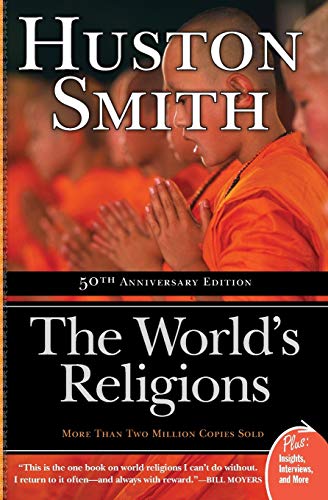
The World's Religions
Huston Smith
The most widely read introduction to world religions ever written — a warm, authoritative survey of Hinduism, Buddhism, Confucianism, Taoism, Islam, Judaism, Christianity, and the primal religions.
View on AmazonExplore other subjects
Foundations
Humanities & Arts