
Engineering
How Things Work
Engineering for Curious Minds
A clear, accessible guide to how the built world is designed and made — Expanded Edition
Introduction
Engineering is the practical art of making things work. It is how we turn ideas into bridges that stay up, phones that connect us, planes that fly, and systems that keep cities running. Wherever something useful has been designed, built, and made to function reliably, engineering has played a part.
Most of us live surrounded by the results of engineering without ever thinking about how those results came to be. We switch on a light, drive across a bridge, or use a phone without needing to understand the decisions, calculations, and compromises that made those things possible. This book explains the core ideas behind engineering in plain language, without requiring any technical background.
You do not need to be good at maths or science to follow it. You only need curiosity about how the physical world is shaped by human ingenuity. Whether you want a clearer understanding of the technology around you, are considering a career in the field, or simply enjoy knowing how things work, the same fundamental principles apply.
We begin by asking what engineering actually is and how it differs from pure science or craftsmanship. From there we look at the design process that engineers follow, the materials they choose, and the ways they make structures strong and machines move. We explore energy, electronics, and the art of combining many parts into working systems. Finally, we examine safety, failure, and the realities of engineering in the wider world.
Each chapter stands on its own, but together they form a clear picture of how engineers think and work. By the end of this book you will understand the forces and principles that shape the built environment around you — and you will see more clearly why some things succeed while others fail. The built world is not accidental. It is the result of deliberate choices made under real constraints. Understanding those choices is one of the most useful ways of understanding the modern world itself. So let's begin with the foundation: what engineering actually is.
Chapter 1: What Engineering Actually Is
Engineering is the disciplined practice of solving practical problems by designing and building things that work. It sits between pure science and pure craftsmanship. Scientists seek to understand how the world works. Craftspeople make things by hand with skill and experience. Engineers use scientific knowledge, practical judgement, and systematic methods to create reliable solutions that can be repeated and scaled.
Constraints and Compromise
At its heart, engineering is about constraints. An engineer rarely has unlimited time, money, materials, or freedom. The task is to find a solution that meets the need while respecting those limits. A bridge must carry traffic safely, but it must also be affordable to build and maintain. A phone must be powerful, but it must also be light, energy-efficient, and cheap enough for people to buy. Engineering is the art of making the best possible compromise under real conditions.
This focus on constraints is what separates engineering from pure invention or pure science. An idea that works only in ideal conditions is not yet an engineered solution. An engineered solution must work in the messy world of limited budgets, imperfect materials, varying users, and unexpected events. The skill lies in finding the point where performance, cost, safety and practicality meet. That point is rarely obvious at the start; it emerges through careful thought and testing.
The Range of Engineering
Engineers work across many fields. Civil engineers deal with infrastructure such as roads, bridges, and water systems. Mechanical engineers focus on machines and moving parts. Electrical and electronic engineers work with power and circuits. Chemical engineers design processes that transform materials. Software and systems engineers create the control and information layers that run modern technology. Despite these differences, they share a common way of thinking: define the problem clearly, generate possible solutions, test them, and refine the best one.
Engineering is not just about inventing new things. Much of it involves improving existing ones, making them safer, cheaper, more efficient, or more reliable. It is also about preventing failure. A good engineer thinks as carefully about what could go wrong as about what should go right. The best solutions often look simple once they exist, but that simplicity is the result of careful thought about constraints, risks, and long-term behaviour. What looks obvious in hindsight was usually the product of many discarded alternatives.
By the end of this chapter you can see that engineering is not primarily about equations or technical drawings. It is a practical problem-solving discipline focused on creating things that work reliably within real-world limits. Everything else in this book builds on that foundation.
- Engineering sits between science and craftsmanship: it uses knowledge to create working solutions.
- Constraints of cost, time, materials and safety shape every design.
- Much of engineering is about improving existing things and preventing failure.
- The core method is define, generate, test, and refine.
Chapter 2: The Design Process – From Idea to Reality
Engineering does not begin with a finished product. It begins with a problem or a need. The design process is the structured way engineers move from that starting point to something that actually works.
Defining the Problem Clearly
The process usually starts by defining the problem clearly. What exactly needs to be achieved? Who will use it? What are the constraints — cost, time, safety, materials, regulations? A vague goal such as "make a better chair" is far less useful than a precise one: "design a chair that is comfortable for eight hours of office work, costs less than a set amount to manufacture, and can be assembled quickly." Clear definition prevents wasted effort later and gives everyone involved a shared target.
Good problem definition also includes understanding the users and the context. A design that works perfectly in a laboratory may fail in a busy factory, a wet climate, or the hands of someone with limited strength or experience. Engineers therefore spend time observing how people actually use similar products and what frustrations or risks appear in real settings. The better the problem is understood, the more likely the solution is to succeed.
Generating Ideas and Testing Them
Once the problem is defined, engineers generate possible solutions. This stage values quantity and variety. Ideas are sketched, discussed, and compared. Some will be impractical; others may contain the seed of a workable design. The aim is not to find the perfect answer immediately, but to explore the range of possibilities before committing resources to detailed development.
The most promising ideas are then developed in more detail. Calculations, models, and prototypes are used to test whether the design can meet the requirements. Prototypes are especially valuable because they reveal problems that are hard to spot on paper. A design that looks good in theory often behaves differently when built. Early, rough prototypes can save large amounts of time and money by exposing flaws before they become expensive to fix.
Testing and refinement follow. Failures at this stage are expected and useful. Each test provides information that improves the next version. The process is rarely linear. Engineers often return to earlier stages when new information appears or when a promising path proves unworkable. Finally, the design is prepared for production or construction. This involves detailed specifications, material choices, manufacturing methods, and plans for maintenance. A design is only successful if it can be made reliably and used safely over time. The finished product is the visible result of many cycles of thinking, making, and learning.
- Good design begins with a clear statement of the problem and its constraints.
- Many ideas are generated before the best ones are developed in detail.
- Prototypes and tests reveal problems that theory alone cannot.
- The process is cyclical: define, invent, test, refine, and prepare for real use.
Chapter 3: Materials – Choosing What to Build With
Every engineered object is made from something. The choice of material is one of the most important decisions an engineer makes, because it affects strength, weight, cost, durability, appearance, and how the object can be manufactured.
Properties That Matter
Materials are chosen for their properties. Strength tells us how much force something can withstand before it breaks or permanently bends. Stiffness describes how much it resists bending or stretching. Density affects weight. Toughness measures resistance to cracking. Other properties include resistance to heat, corrosion, wear, and electrical or thermal conductivity. No material is best at everything. The engineer's job is to select the one that best matches the demands of the design while remaining practical to obtain and use.
Sometimes the decisive property is not the most obvious one. A material that is strong enough may still be unsuitable if it corrodes too quickly, becomes brittle in cold weather, or cannot be joined reliably to other parts. Engineers therefore look at the full set of properties under the conditions the product will actually face, not just under ideal laboratory conditions.
Families of Materials and Practical Choices
Common engineering materials fall into broad families. Metals such as steel and aluminium are strong, relatively tough, and can be shaped in many ways. Concrete is excellent in compression and cheap for large structures. Plastics and polymers are light, versatile, and often inexpensive, though they can be weaker and more sensitive to heat. Ceramics are hard and heat-resistant but brittle. Composites combine materials to gain the advantages of each — for example, carbon-fibre materials that are both light and very strong.
Cost and availability matter as much as performance. A material that is perfect in theory may be impractical if it is too expensive, difficult to obtain, or hard to work with. Manufacturing methods also influence the choice. Some materials are easy to cast, others to machine, weld, or mould. The best material is the one that meets the performance requirements while remaining realistic to produce.
Engineers also consider the full life of the product. Will the material corrode, fatigue, or degrade over time? Can it be recycled or repaired? Environmental impact and sustainability are increasingly part of the decision. The right material makes a design possible; the wrong one can cause it to fail quietly over years or suddenly under stress. Material choice is therefore never just a technical decision — it is also a practical and long-term one.
- Material choice affects strength, weight, cost, durability and manufacturability.
- No single material is best at everything; the right balance is the goal.
- Metals, concrete, plastics, ceramics and composites each have distinctive strengths.
- Cost, availability, manufacturing method and long-term behaviour all matter.
Chapter 4: Structures – Making Things Stand Up
A structure is anything designed to carry loads and remain stable. Buildings, bridges, towers, aircraft frames, and even the chassis of a car are all structures. The central task of structural engineering is to ensure that these things stand up safely under the forces they will experience.
Forces and How Structures Resist Them
Forces on a structure include its own weight, the weight of people or vehicles, wind, snow, earthquakes, and temperature changes. These forces create internal stresses — pushing, pulling, bending, or twisting the material. If the stresses become too high, the structure may deform permanently or collapse.
Engineers shape structures to manage these forces efficiently. Beams carry loads across spans. Columns support weight from above. Trusses use triangular arrangements to create strong, lightweight frameworks. Arches convert downward forces into outward thrusts that can be resisted by supports. The form of a structure is often as important as the material it is made from. A well-chosen shape can carry far more load than a poorly chosen one made of the same material. This is why the geometry of a bridge or a roof is designed with as much care as the choice of steel or concrete.
Stability, Safety Margins and Real Conditions
Stability is as critical as strength. A structure can be strong enough in its parts yet still fail if it tips, buckles, or sways excessively. Good design keeps the centre of gravity low, provides adequate bracing, and ensures that loads travel safely down to the foundations.
Safety margins are built into structural design. Engineers calculate the expected loads and then design the structure to withstand significantly more. This accounts for uncertainties in materials, construction quality, and unexpected events. The goal is not perfection, but reliable performance under real conditions. A well-designed structure does its job quietly and continuously, often for decades, without demanding attention. When failures do occur, careful investigation usually shows that the problem began at a detail that was overlooked rather than in the main concept. Learning from those details is how structural practice improves over time.
- Structures must carry loads safely and remain stable.
- Form — beams, columns, trusses, arches — is as important as material.
- Stability against tipping, buckling or excessive movement is essential.
- Safety margins account for uncertainty and unexpected events.
Chapter 5: Machines and Motion
Machines are devices that use energy to perform useful work, usually by controlling motion. They multiply force, change direction, increase speed, or convert one type of movement into another. From simple tools like levers and pulleys to complex engines and robots, machines extend human capability.
Basic Mechanisms
At the most basic level, machines rely on a few elementary principles. A lever allows a small force applied over a longer distance to move a heavier load over a shorter distance. Pulleys change the direction of a force and can reduce the effort needed to lift something. Gears transmit rotation and can increase torque or speed. Wheels and axles reduce friction and enable efficient movement. These simple mechanisms are combined in countless ways to create more sophisticated machines. Almost every complex machine can be understood as an arrangement of these basic elements working together.
Controlling Motion and Choosing Power
Motion in machines is carefully controlled. Engineers decide whether parts should rotate, slide, swing, or follow a precise path. Linkages, cams, and cranks convert rotary motion into linear motion or vice versa. Bearings reduce friction so that parts can move smoothly and last longer. The goal is to achieve the desired movement with as little wasted energy as possible.
Power sources drive machines. Early machines relied on human or animal muscle, wind, or water. Later came steam engines, internal combustion engines, electric motors, and hydraulic systems. Each power source has strengths and limitations in terms of power, efficiency, size, and control. Matching the right power source to the task is a key engineering decision.
Reliability and efficiency matter greatly. A machine that works well in theory but wears out quickly, wastes energy, or requires constant adjustment is of limited value. Good mechanical design considers lubrication, wear, heat, vibration, and ease of maintenance from the start. The best machines feel almost inevitable once they exist — as if the motion and the means were made for each other. That feeling is usually the result of many careful decisions about how forces move through the system.
- Machines control motion and multiply or redirect force.
- Simple mechanisms — levers, pulleys, gears, wheels — combine into complex machines.
- Power sources must be matched to the task.
- Durability, efficiency and ease of maintenance are part of good design.
Chapter 6: Energy and Power
Energy is the capacity to do work. Power is the rate at which energy is used or transferred. Almost every engineered system depends on a reliable supply of energy and the ability to convert it into useful forms.
Forms of Energy and the Cost of Conversion
Energy exists in many forms: motion, stored position or state, heat, chemical energy, electricity, and others. Engineering is largely concerned with converting energy from one form to another as efficiently as possible. A car engine converts chemical energy in fuel into mechanical motion. A solar panel converts light into electricity. A battery stores chemical energy and releases it as electrical energy when needed.
No conversion is perfect. Some energy is always lost, usually as heat. Efficiency measures how much of the input energy ends up in the desired form. Improving efficiency reduces waste, lowers costs, and lessens environmental impact. Much of modern engineering effort goes into making energy conversions cleaner and more effective. Even small improvements in efficiency can have large effects when applied across millions of devices or long periods of time.
Matching Supply, Demand and Safety
Power systems must also match supply to demand. Electricity grids balance generation with consumption in real time. Vehicles need enough power for acceleration yet must conserve energy during steady travel. Engineers design systems that can deliver the right amount of power when it is required, while storing or managing excess when it is not.
Safety and control are critical. High-energy systems can be dangerous if they fail. Engineers build in protections, monitoring, and fail-safes so that energy is released only in controlled ways. From pressure relief valves to circuit breakers, these features are essential parts of energy engineering. Good engineering treats energy not as an unlimited resource, but as something to be used carefully and efficiently. The ability to harness, convert, store, and control energy reliably is what makes modern technology possible.
- Energy is the capacity to do work; power is the rate of its use.
- Engineering converts energy between forms as efficiently as possible.
- Some energy is always lost, usually as heat.
- Safety systems are essential when dealing with high-energy processes.
Chapter 7: Electronics and Control Systems
Electronics is the branch of engineering that deals with the controlled flow of electricity through circuits to process information, sense conditions, and control devices. Almost every modern machine contains electronic systems, from simple switches and sensors to sophisticated computers.
Circuits, Sensors and Actuators
At the most basic level, electronic circuits use components to manage voltage and current. These components can amplify signals, switch power on and off, store information, and perform logical operations. The invention of the transistor and later the microchip made it possible to pack enormous capability into tiny spaces at low cost. What once required rooms full of equipment now fits in a pocket or on a single board.
Sensors allow electronic systems to gather information from the physical world. They measure temperature, pressure, light, motion, position, and many other variables, converting them into electrical signals. Actuators do the reverse: they take electrical signals and produce physical actions, such as moving a motor, opening a valve, or displaying information. Together, sensors and actuators give machines the ability to perceive and act on their surroundings.
Control, Feedback and Reliability
Control systems use this information to keep a process or machine operating as intended. A simple example is a thermostat that turns heating on or off to maintain a set temperature. More advanced systems continuously adjust multiple variables in real time — for example, the flight control systems in an aircraft or the engine management system in a car. Feedback is the key idea: the system measures the result of its actions and corrects itself.
Reliability and robustness are essential. Electronic systems must cope with noise, temperature changes, power fluctuations, and component failures. Good design includes shielding, error checking, redundancy where necessary, and clear behaviour when something goes wrong. Electronics and control systems turn passive machines into active, adaptive systems. This capability underpins almost all modern technology, from household appliances to large industrial plants and transport systems. The quiet reliability of these systems is easy to take for granted until something fails.
- Electronics control the flow of electricity to process information and control devices.
- Sensors gather data from the world; actuators produce physical actions.
- Feedback allows systems to measure results and correct themselves.
- Reliability under real conditions is a central design requirement.
Chapter 8: Systems Thinking – Putting It All Together
Most real engineering problems involve more than one part working in isolation. A car is not just an engine, or a structure, or an electronic system — it is all of these things combined, along with many others, into a single functioning whole. Systems thinking is the ability to understand how the parts interact and how the whole behaves.
Interactions and Interfaces
A system is a set of components that work together for a purpose. The behaviour of the system often depends as much on the connections between the parts as on the parts themselves. Changing one element can affect many others, sometimes in unexpected ways. Good engineers learn to look beyond individual components and consider the wider interactions.
Interfaces are critical. Wherever two parts of a system meet — mechanical, electrical, digital, or human — there is potential for problems. Clear specifications, compatible standards, and careful design of these interfaces help the system work smoothly. Many failures occur not because a single part is weak, but because the connections between parts were poorly thought through. The places where subsystems meet are often where the most careful attention is required.
Managing Complexity and Emergent Behaviour
Complexity grows quickly as systems become larger. Engineers manage this by breaking systems into subsystems, defining clear responsibilities for each, and using modular designs that can be developed and tested somewhat independently. Hierarchy and abstraction help: one can understand a system at a high level without knowing every detail of its internal workings.
Sometimes a system displays properties that none of its individual parts possess on their own. These can be useful or problematic. Systems thinking helps engineers anticipate and shape these outcomes rather than being surprised by them. Modern engineering is rarely about isolated inventions. It is about integrating materials, structures, machines, energy, and electronics into coherent systems that perform reliably over time and under varying conditions. The ability to think in systems is what allows engineers to create complex, working technology that feels simple to the user.
- Real products are systems of interacting parts, not isolated components.
- Interfaces between parts are common sources of problems.
- Complexity is managed by modular design and clear responsibilities.
- The behaviour of the whole can differ from the sum of the parts.
Chapter 9: Safety, Reliability, and Failure
Every engineered system will eventually face conditions it was not fully designed for, or will degrade over time. Safety and reliability are therefore central concerns in engineering. The goal is not to eliminate all risk — that is impossible — but to reduce risk to acceptable levels and to ensure that when failures occur, they do so in controlled and predictable ways.
Reliability and Safety in Practice
Reliability means consistent performance over time. A reliable product or structure does what it is supposed to do, for as long as it is supposed to do it, under the expected conditions. Engineers improve reliability through careful design, quality materials, thorough testing, and attention to wear, fatigue, corrosion, and other forms of degradation. A design that works perfectly on the first day but deteriorates rapidly is not a successful design.
Safety focuses on protecting people, property, and the environment from harm. This involves identifying hazards, estimating the likelihood and consequences of failures, and putting measures in place to prevent or mitigate them. Safety factors, redundant systems, protective devices, warning systems, and clear operating procedures all play a part. The best safety features are often those that the user never has to think about because they quietly prevent problems before they arise.
Learning from Failure and Judging Risk
Failure itself is a valuable teacher. When something breaks or malfunctions, careful investigation can reveal weaknesses in design, materials, manufacturing, or use. Many improvements in engineering practice have come from analysing accidents and near-misses. A mature engineering culture treats failure as information rather than simply as blame.
Risk is never zero. Engineers and society must decide what level of risk is acceptable for a given activity. A bridge is designed to extremely high safety standards because the consequences of collapse are severe. A consumer product may accept slightly higher risk in exchange for lower cost and greater convenience. These judgements involve both technical analysis and social values. Safety and reliability are not optional extras. They are integral to responsible engineering. Understanding how things fail, and designing to manage that failure, is as important as understanding how to make them work in the first place.
- Reliability means consistent performance under expected conditions.
- Safety involves identifying hazards and reducing risk to acceptable levels.
- Failure analysis is a valuable source of improvement.
- Risk can never be zero; the question is what level is acceptable.
Chapter 10: Engineering in the Real World
Engineering does not take place in isolation. It happens within budgets, regulations, timelines, politics, markets, and human organisations. Understanding these real-world conditions is as important as mastering the technical principles.
Constraints Beyond Physics
Projects are shaped by constraints that go beyond physics. Cost limits what can be built. Schedules determine how thoroughly designs can be refined. Regulations set minimum standards for safety and environmental impact. Clients and users have expectations that may shift during the work. Engineers must navigate these pressures while still delivering something that functions reliably. The ability to work effectively inside these constraints is as much a professional skill as technical knowledge.
Large projects involve many disciplines working together. Civil, mechanical, electrical, software, and other specialists must coordinate their efforts. Clear communication, shared standards, and strong project management become essential. Misunderstandings between teams are a common source of delay and error. The technical solution is only part of the work; the human and organisational solution is the other part.
Responsibility and the Nature of Progress
Engineering also carries social responsibility. The things engineers create affect public safety, the environment, and quality of life. Ethical practice requires honesty about risks, resistance to cutting corners when safety is involved, and consideration of long-term consequences. Codes of conduct and professional institutions exist to support these standards.
Innovation continues, but it is rarely a sudden leap. Most progress comes from steady improvement, better materials, more precise manufacturing, improved modelling tools, and lessons learned from previous projects. Digital tools, simulation, and data analysis are changing how engineers work, yet the fundamental need for sound judgement remains. Engineering in practice is both a technical and a human activity. Success depends not only on getting the calculations right, but on working effectively within real constraints, collaborating across disciplines, and accepting responsibility for the consequences of what is built.
- Real projects are shaped by cost, time, regulation and human factors.
- Large projects require coordination across many disciplines.
- Ethical responsibility for safety and long-term effects is part of the role.
- Most progress comes from steady improvement rather than sudden leaps.
Conclusion: The Practice of Making Things Work
Engineering is the disciplined craft of turning ideas into reliable reality. It takes scientific understanding, practical judgement, and careful process, then applies them within the constraints of the real world.
We have seen that engineering begins with clear problem definition and follows a cycle of design, testing, and refinement. It depends on choosing the right materials, shaping structures that can carry loads, creating machines that control motion, and managing energy efficiently. Electronics and control systems give modern designs the ability to sense and respond. Systems thinking allows these elements to work together. Throughout, safety, reliability, and an honest understanding of failure remain essential. And all of this takes place inside the practical realities of cost, regulation, collaboration, and responsibility.
These principles apply whether the project is a simple tool or a complex piece of infrastructure. The scale changes. The tools change. The underlying approach does not.
Engineering is not a mysterious art reserved for specialists. It is a practical way of thinking that can be understood and appreciated by anyone willing to look carefully at how things are made and why they succeed or fail. The more clearly we see these processes, the better we can evaluate the technology around us, contribute to it, or simply use it with greater understanding.
By the end of this book you can see that engineering, at its best, is a constructive force. It solves problems, shapes the built environment, and expands what is possible. Understanding how it works is one of the most useful ways of understanding the modern world itself. The built world is the visible record of countless engineering decisions. Once you begin to notice those decisions, the world around you becomes a more interesting place.
Further Reading
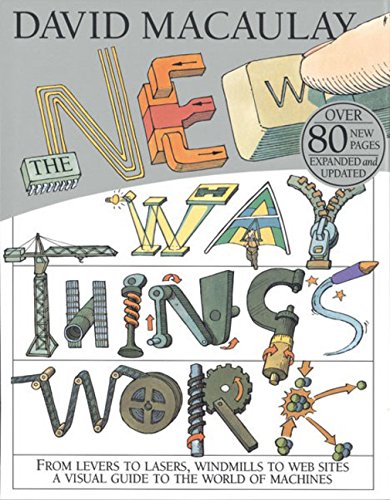
The Way Things Work
David Macaulay
The definitive illustrated guide to how machines and technology work — from levers and gears to computers and digital technology. Macaulay explains engineering principles with remarkable clarity and wit, making it the perfect starting point for curious minds of any age.
View on AmazonExplore other subjects
Foundations
Social Sciences
Humanities & Arts
Applied & Professional