
Law
How the Law Works
Law for Curious Minds
Expanded Edition
Introduction
Law is the system of rules that a society creates and enforces to regulate behaviour, resolve disputes, and maintain order. It sets out what people may do, what they must do, and what they must not do, and it provides mechanisms for dealing with those who break the rules or fall into conflict with one another.
Most of us encounter the law only occasionally — when we sign a contract, receive a fine, buy a house, or serve on a jury. Yet law shapes daily life in countless quieter ways. It underpins property, business, family relationships, public safety, and the limits of government power. Understanding its basic principles makes the social world more intelligible.
This book explains the core ideas of law in plain language. You do not need any legal training or prior knowledge. The aim is to give a clear overview of how legal systems work, what the main branches of law deal with, and how legal rules affect ordinary people. While details vary between countries, the fundamental concepts are widely shared.
Each chapter stands on its own, but together they form a coherent picture of the legal system. By the end of this book you will understand the basic structure and purpose of law — and you will be better equipped to make sense of legal issues when they arise. Law is not a remote technical subject. It is one of the main ways societies organise themselves. The clearer our grasp of its basic ideas, the less mysterious and more navigable the legal world becomes.
Chapter 1
What Law Actually Is
Law is a system of rules created and enforced by a society through its institutions, usually the state. These rules govern behaviour, define rights and duties, and provide ways to resolve disputes. Unlike personal morals or social customs, law carries the formal authority of the community and can be backed by official sanctions such as fines, imprisonment, or court orders.
Law and Other Kinds of Rules
Not every rule is law. Manners, religious teachings, and workplace guidelines influence behaviour, but they are not usually enforced by the courts. Law is distinctive because it is publicly declared, generally applicable, and supported by institutions with the power to interpret and enforce it. When people speak of "the rule of law," they mean that everyone, including those in power, is subject to the same legal rules applied in a predictable way.
This public character matters. Private rules can be useful, but only law claims the authority of the whole community and can call on official force if necessary. That power is why legal systems also build in limits and procedures — to prevent the same authority from being used arbitrarily. The difference between a personal moral code and a legal rule is not always the content of the rule, but the source of its authority and the consequences of breaking it.
What Law Is For
Law serves several purposes. It maintains order by prohibiting harmful conduct. It provides a framework for cooperation, such as contracts and property rights, so that people can plan and exchange with confidence. It offers mechanisms for resolving conflicts without private force. And in many systems it protects certain fundamental rights against both other individuals and the state itself.
Legal rules can be found in different forms: constitutions, statutes passed by legislatures, regulations made by government bodies, and decisions of courts that interpret and develop the law. Together these sources create a body of law that is meant to be knowable and relatively stable, even as it adapts to new circumstances.
Key Takeaways
- Law is a system of publicly enforced rules that regulate behaviour and resolve disputes.
- It differs from morals and customs because it carries formal authority and sanctions.
- The rule of law means that everyone, including those in power, is subject to the same rules.
- Law maintains order, enables cooperation, resolves conflict, and can protect rights.
Chapter 2
Where Laws Come From
Laws come from several recognised sources. The most familiar is legislation — rules formally enacted by a parliament, congress, or other law-making body. These statutes cover everything from criminal offences to tax, employment, and environmental protection. Once passed, they apply generally until amended or repealed.
Constitutions, Courts and Regulations
In many countries a constitution stands above ordinary legislation. It sets out the basic structure of government and often protects fundamental rights. Ordinary laws that conflict with the constitution can be struck down by the courts. The constitution is therefore both a source of law and a limit on other sources. It provides a higher set of rules against which ordinary laws can be measured.
Courts also create law through their decisions. When judges interpret statutes or develop principles in areas not fully covered by legislation, their rulings become precedents that guide future cases. This body of judge-made law is often called the common law. Over time it builds a detailed framework of rules through accumulated decisions. Later courts are expected to follow earlier ones in similar situations, which promotes consistency.
Government departments and agencies produce regulations and secondary legislation under powers granted by statute. These rules fill in practical details — for example, safety standards or licensing requirements. Although made by the executive rather than the legislature, they still have legal force. They can usually be challenged if they go beyond the authority granted by the parent statute.
A Mix of Sources
Custom and international agreements can also influence domestic law, though usually only when recognised by legislation or the courts. The mix of sources varies between legal systems, but most modern systems rely on a combination of written statutes, constitutional principles, and judicial interpretation. Understanding where a rule comes from helps in understanding how authoritative it is and how it might be changed.
Key Takeaways
- Legislation from elected bodies is a primary source of law.
- Constitutions sit above ordinary laws and can limit them.
- Court decisions create and develop law through precedent.
- Regulations fill in practical details under powers granted by statute.
Chapter 3
Courts and How Cases Work
Courts are the institutions that interpret and apply the law to particular disputes. They decide what the law means in concrete situations, resolve conflicts between parties, and in criminal cases determine guilt and sentence.
The Court Hierarchy and the Trial Process
Most systems have a hierarchy of courts. Lower courts handle routine cases. Higher courts hear appeals and deal with more serious or complex matters. At the top sits a final court of appeal whose decisions bind the courts below. This structure promotes consistency and allows errors to be corrected. It also means that important questions of law can be settled authoritatively for the whole system.
A typical case begins when one party brings a claim or the state brings a prosecution. The parties present evidence and legal arguments. The judge (and in some systems a jury) examines the facts, applies the relevant law, and reaches a decision. The losing party may often appeal on points of law. Appeals are usually about whether the law was applied correctly, not about re-hearing all the evidence.
Procedure, Fairness and Independence
Courts follow procedural rules that govern how evidence is presented, how witnesses are examined, and how fairness is maintained. These procedures are designed to give both sides a proper opportunity to be heard and to produce reliable outcomes. Public hearings and reasoned judgments help keep the process accountable. The requirement to give reasons is especially important: it forces the decision-maker to explain the result and allows others to assess whether the reasoning is sound.
Judges are expected to be independent and impartial. Their role is to apply the law rather than to pursue personal or political preferences. In practice this ideal is supported by security of tenure, ethical rules, and the requirement to give reasons for decisions. Independence does not mean isolation from society; it means freedom from improper pressure in deciding individual cases.
Key Takeaways
- Courts interpret and apply the law to particular cases.
- A hierarchy of courts allows appeals and promotes consistency.
- Procedural rules aim to ensure fairness and reliable outcomes.
- Judicial independence supports impartial application of the law.
Chapter 4
Criminal Law – Crime and Punishment
Criminal law deals with behaviour that society has defined as offences against the public. Crimes such as theft, assault, fraud, and murder are prosecuted by the state, not by the individual victim. The aim is to maintain public order, deter harmful conduct, and impose punishment where appropriate.
What Makes Something a Crime
A crime usually requires both a prohibited act and a guilty state of mind. The exact mental element varies: some offences require intention, others recklessness or negligence. The prosecution must prove the case to a high standard — beyond reasonable doubt in most systems — because the consequences of conviction are serious. This high standard is a deliberate choice: it is better, the traditional view holds, that some guilty people go free than that an innocent person is convicted.
When someone is found guilty, the court imposes a sentence. Possible penalties include fines, community service, imprisonment, or other restrictions. Sentencing tries to balance several goals: punishment, deterrence, rehabilitation, and public protection. The severity of the sentence generally reflects the seriousness of the offence and the circumstances of the offender. Judges usually work within guidelines or statutory limits that constrain their discretion.
Safeguards and the Line Between Public and Private
Criminal procedure includes important safeguards. Suspects have rights to legal advice, to remain silent, and to a fair trial. These protections exist because the power of the state is great and the risk of wrongful conviction is real. The system is designed to prefer letting the guilty go free over convicting the innocent. These safeguards can slow the process and sometimes frustrate victims, but they are regarded as essential to legitimacy.
Criminal law draws a line between private wrongs and public wrongs. Not every harmful act is a crime; many are left to civil law. The decision to criminalise conduct reflects social values about what must be forbidden and punished by the community as a whole. That decision can change over time as values change.
Key Takeaways
- Criminal law deals with offences against the public, prosecuted by the state.
- Guilt usually requires both a prohibited act and a guilty state of mind.
- The standard of proof is high because the consequences are serious.
- Safeguards protect suspects because state power is great.
Chapter 5
Civil Law – Disputes Between People
Civil law deals with disputes between individuals, companies, or other private parties. Unlike criminal law, the state does not prosecute. One party (the claimant) sues another (the defendant) seeking a remedy, usually compensation or a court order to do or stop doing something.
Types of Claims and Remedies
Common types of civil claims include breach of contract, negligence (carelessly causing harm), nuisance, and disputes over property or inheritance. The standard of proof is lower than in criminal cases — usually the balance of probabilities — because the consequences are typically financial rather than loss of liberty. It is enough that the claim is more likely than not to be true.
The main remedy in civil law is damages: a sum of money intended to put the injured party in the position they would have been in if the wrong had not occurred. In some cases the court can order specific performance (forcing a party to carry out a promise) or an injunction (ordering someone to stop certain behaviour). The focus is on practical redress rather than punishment.
Practical Realities
Civil litigation can be expensive and time-consuming. Many systems encourage settlement and alternative dispute resolution such as mediation. The goal is to resolve the conflict fairly without always needing a full trial. A negotiated settlement often leaves both parties better off than a hard-fought judgment, even if neither gets everything they wanted.
Civil law underpins everyday cooperation. It gives people confidence to make agreements, rely on others' carefulness, and protect their interests knowing that a neutral forum exists if things go wrong. Without it, many ordinary transactions would be riskier.
Key Takeaways
- Civil law deals with private disputes between individuals or organisations.
- The main remedy is usually compensation (damages).
- The standard of proof is lower than in criminal cases.
- Settlement and mediation are often encouraged to avoid full trials.
Chapter 6
Rights and Freedoms
Many legal systems protect certain fundamental rights and freedoms. These may include freedom of expression, freedom of religion, the right to a fair trial, protection from arbitrary detention, and equality before the law. Some rights concern political participation; others protect personal autonomy and dignity.
Where Rights Come From and How They Work
Rights can be protected by a constitution, by ordinary legislation, or by international treaties that a country has accepted. Constitutional rights are usually harder to change and can be enforced against the government itself. This is one of the main ways law limits public power. When a right is constitutional, even a majority in the legislature may not be able to override it easily.
Rights are rarely absolute. Most can be restricted for good reasons, such as public safety, the rights of others, or national security, provided the restriction is proportionate. Courts often decide where the balance lies when rights conflict with each other or with important public interests. The idea of proportionality is central: the restriction should not go further than necessary to achieve the legitimate aim.
The Expanding Idea of Rights
The idea of rights has expanded over time. Early protections focused on liberty from state interference. Later developments added social and economic rights, and stronger protections against discrimination. Debates continue about which interests should be treated as fundamental rights and how far they should reach. These debates are partly legal and partly political.
Rights give individuals a powerful claim against both the state and, in some cases, other private parties. They turn moral or political aspirations into enforceable legal standards and provide a language for challenging injustice.
Key Takeaways
- Fundamental rights protect important interests such as expression, fair trial and equality.
- They can be found in constitutions, statutes and international agreements.
- Most rights can be limited for good reasons if the limit is proportionate.
- Rights give individuals enforceable claims against power.
Chapter 7
Contracts and Everyday Agreements
A contract is a legally binding agreement between two or more parties. It creates rights and duties that the courts will enforce. Contracts are the legal foundation of buying and selling, employment, renting property, and countless other everyday transactions.
How Contracts Are Formed
For a contract to exist there usually needs to be an offer, acceptance of that offer, and some form of exchange (consideration in many systems). The parties must intend to create legal relations, and they must have the capacity to contract. The terms must be sufficiently clear. If these elements are present, the agreement becomes more than a social understanding; it becomes enforceable in court.
Once formed, a contract obliges the parties to do what they promised. If one side fails without a valid excuse, the other can seek a remedy — usually damages to compensate for the loss caused by the breach. In limited cases the court may order the defaulting party to perform the contract. The ordinary remedy, however, is money rather than forced performance.
Limits and Everyday Importance
Not every promise is a contract. Social arrangements and casual agreements often lack the intention to be legally binding. The law also refuses to enforce some agreements, for example those involving illegal purposes or extreme unfairness in certain contexts. Capacity rules protect minors and some vulnerable people from being bound by agreements they are not in a position to understand fully.
Contract law allows people to plan and cooperate with confidence. By making agreements enforceable, it reduces the risk of relying on others and supports complex economic and social activity. Most contracts are performed without any dispute; the law is there for when things go wrong.
Key Takeaways
- A contract is a legally enforceable agreement between parties.
- It usually requires offer, acceptance, exchange and intention to be bound.
- Breach can lead to damages or, in limited cases, an order to perform.
- Contract law underpins everyday buying, selling, employment and renting.
Chapter 8
Property and Ownership
Property law governs the rights people have over things — land, buildings, goods, and in modern systems also intellectual property such as copyrights and patents. Ownership is the most complete form of property right, but there are many lesser rights as well, such as leases, mortgages, and easements.
What Ownership Means
Owning something generally means the right to use it, exclude others from it, and transfer it. These rights are not absolute. Planning laws, environmental rules, and the rights of neighbours can restrict what an owner may do. Property exists within a framework of social regulation. Absolute ownership in the sense of complete freedom from all limits is rare.
Land has always been treated specially because it is permanent and limited. Systems of registration help make ownership clear and transfers secure. Personal property (movable goods) follows somewhat different rules, often simpler because the items themselves can change hands more easily. Clarity of title matters for both: people need to know who owns what if they are to buy, sell, or lend with confidence.
Intellectual Property and Security
Intellectual property protects creations of the mind. Copyright, patents, and trademarks give creators and inventors temporary exclusive rights so they can benefit from their work. These rights try to balance the reward for innovation with the wider public interest in access and further development. The temporary nature of most intellectual property rights is deliberate: after a period the creation enters the public domain.
Property law provides the security that allows people to invest, build, and plan for the future. Without clear and enforceable rights over resources, much economic and personal activity would be far more uncertain.
Key Takeaways
- Property law governs rights over land, goods and intellectual creations.
- Ownership includes rights to use, exclude and transfer, subject to limits.
- Land is treated specially because it is permanent and limited.
- Clear property rights support investment, planning and economic activity.
Chapter 9
How Laws Are Made and Changed
Laws are made through established political and institutional processes. In democratic systems the primary law-making body is an elected legislature. Proposals (bills) are debated, amended, and voted on. Once approved and given formal assent, they become statutes.
The Legislative Process and Secondary Rules
The process is designed to be deliberate. Multiple readings, committee scrutiny, and the possibility of amendment allow different views to be heard. This slows change but increases the chance that laws are workable and command broader acceptance. Speed is sometimes sacrificed for legitimacy and quality.
Governments also make secondary legislation under powers given by statute. These regulations handle detailed or technical matters and can be updated more quickly. They remain subordinate to the primary legislation and can be challenged if they go beyond the powers granted. The ability to make detailed rules without returning to the full legislative process is practically necessary, but it also requires oversight.
Courts, Reform and Adaptation
Courts change the law more gradually through interpretation and the development of precedent. When existing rules are unclear or produce unjust results in new situations, judicial decisions can refine or extend them. In some systems courts also have the power to strike down laws that conflict with the constitution. Judicial change is usually incremental rather than dramatic.
Law changes in response to social needs, technological developments, political shifts, and campaigning by interest groups. Reform can be slow, and old rules sometimes persist long after the conditions that produced them have changed. Keeping the law reasonably up to date is a continuing task.
Key Takeaways
- Primary laws are made by elected legislatures through a deliberate process.
- Secondary regulations fill in details under powers granted by statute.
- Courts develop and refine law through interpretation and precedent.
- Law adapts to social, technological and political change, though often slowly.
Chapter 10
Law in Everyday Life
Law is present in ordinary activities even when we do not notice it. Buying goods, starting a job, renting a flat, driving a car, or getting married all involve legal rules. Most of the time these rules operate quietly in the background, providing a framework of expectations and protections.
Practical Areas of Law
Consumer law, employment law, and housing law are practical examples. They set standards for fair dealing, safety, and minimum rights. When something goes wrong — a faulty product, unfair dismissal, or a dispute with a landlord — these rules provide a basis for complaint and remedy. Knowing that such rules exist can change how people behave even when no formal claim is ever made.
Legal awareness helps people recognise when they have rights and when they have duties. It encourages reading important documents, keeping records, and seeking advice early rather than after a problem has escalated. Many disputes can be resolved more easily if the legal position is understood from the start. Prevention and early clarification are often cheaper and less stressful than late confrontation.
Public Debate and Peaceful Order
Law also shapes public debate. Arguments about free speech, privacy, equality, or criminal justice are often conducted in legal language. Understanding the basic concepts makes it easier to follow and evaluate these discussions. Legal concepts supply a shared vocabulary even when people disagree about the right outcome.
Finally, law provides a peaceful alternative to private force. Knowing that disputes can be taken to a neutral forum reduces the temptation to settle them by intimidation or retaliation. This is one of the quiet civilising effects of a working legal system.
Key Takeaways
- Law structures many ordinary activities even when we do not notice it.
- Consumer, employment and housing law provide practical protections.
- Legal awareness helps people recognise rights and duties early.
- Law offers a peaceful alternative to private force in resolving disputes.
Conclusion: Living Under the Law
Law is the public system of rules and institutions through which a society regulates behaviour, protects rights, and resolves disputes. It replaces private force with ordered processes and gives people a framework in which they can plan, cooperate, and challenge unfair treatment.
We have seen that law comes from legislatures, constitutions, courts, and administrative bodies. Courts apply it to concrete cases through structured procedures. Criminal law addresses public wrongs with punishment; civil law deals with private disputes through compensation and remedies. Rights limit power and protect important interests. Contracts and property enable everyday cooperation and security. Laws are made and changed through political and institutional processes, and the whole system reaches into ordinary life in countless practical ways.
Legal systems are imperfect. They can be slow, expensive, or uneven in their application. Yet the alternative — a world without enforceable public rules — is far worse. The rule of law remains one of the most important achievements of organised societies.
Understanding the basic structure and purpose of law does not turn anyone into a lawyer. It does, however, make the legal world less mysterious and helps people recognise both their rights and their responsibilities. That clarity is valuable in itself.
By the end of this book you can see that law is not merely a set of technical rules. It is a central part of how societies maintain order, enable cooperation, and protect individuals. Knowing how it works is a practical form of citizenship.
Further Reading
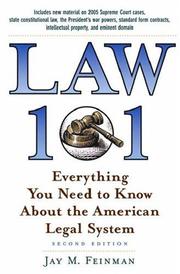
Law 101
Jay Feinman
Jay Feinman's bestselling introduction to American law — covering contracts, torts, criminal law, constitutional law, and more in clear, engaging prose. The perfect starting point for curious minds.
View on AmazonExplore other subjects
Foundations
Social Sciences
Humanities & Arts
Applied & Professional